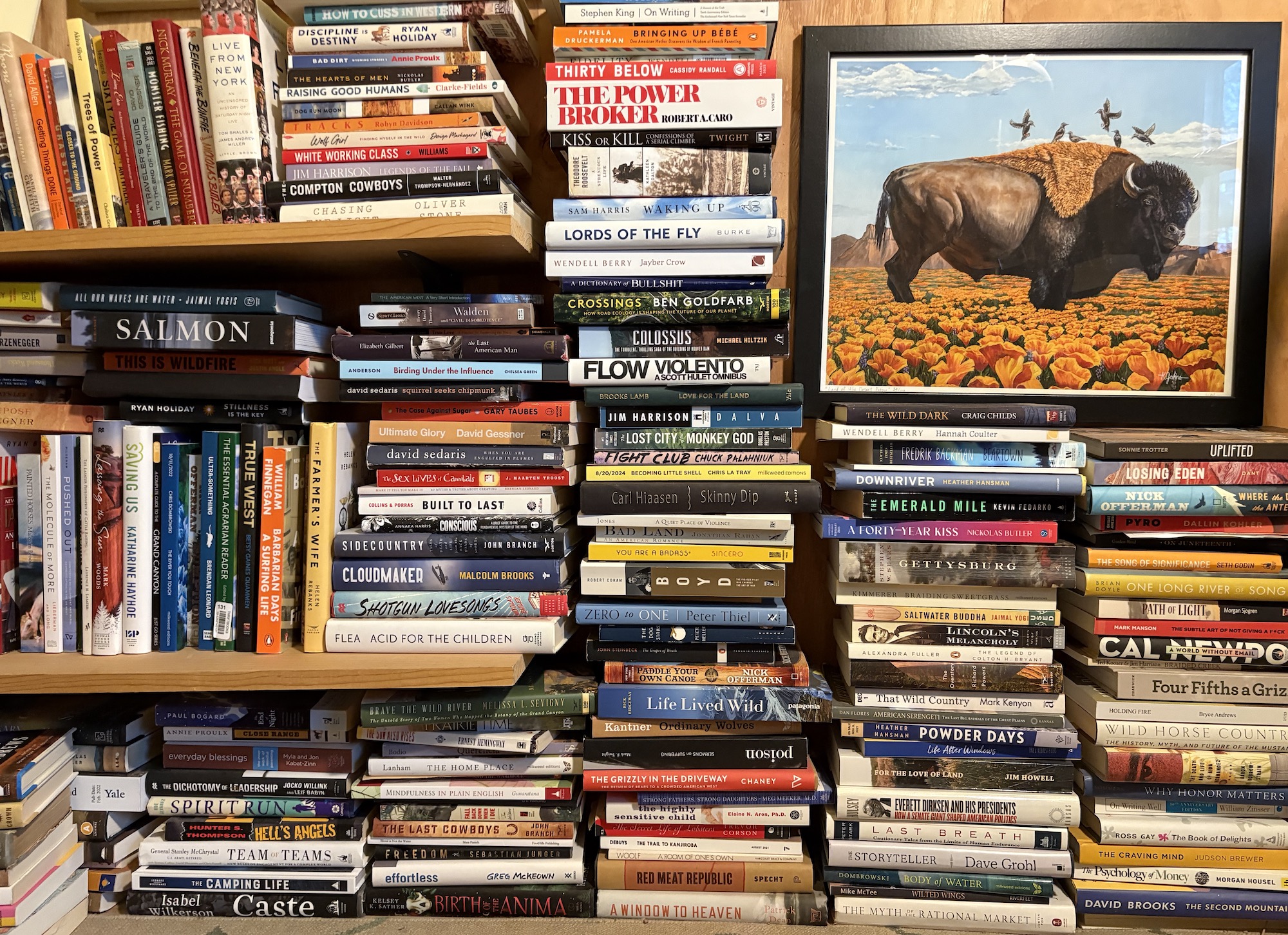
This month marks ten full years of my Bimonthly Book Recommendations—a decade of weird little paragraphs about the books that grab my scattered attention. Whether you’ve been here since the beginning or signed up five minutes ago, thank you. I’m still baffled anyone reads these things, but I’m grateful all the same.
To mark the occasion, I recorded a late-night solo episode from The Shed, diving deeper into each of my September & October picks: why I chose them, what stayed with me, and the sometimes-unexpected lessons I gleaned from each of them. Or you could just describe it as a guy sitting in his garden shed talking to himself. Your choice.
You can read all of the recommendations below, or, if you’re clamoring to receive more emails, you can sign up for the list here:
Thanks for listening, thanks for reading, and here’s to 10 more great years of great books.
LISTEN & DOWNLOAD:
Apple Podcasts
Spotify
… or wherever you get your podcasts!
—
RESOURCES:
Books Discussed:
- 00:00 — Intro + 10 years of book-rec emails
- 05:45 — Burn by Peter Heller
- 11:00 — Jayber Crow by Wendell Berry (related rec)
- 11:45 — The Way Out by Devon O’Neil
- 17:10 — Simple Fly Fishing by Yvon Chouinard
- 21:50 — Pheasant Tail Simplicity by Yvon Chouinard
- 25:40 — Little Woodchucks by Nick Offerman
- 29:20 — Dirtbag Billionaire by David Gelles
- 35:00 — Shoe Dog by Phil Knight (related rec)
- 35:55 — Apple in China by Patrick McGee
- 40:45 — When McKinsey Comes to Town (related rec)
- 42:10 — The Devil’s Hand by Jack Carr
- 46:15 — Closing thoughts + how the book list began
The Book Recommendations:
Burn by Peter Heller – Back in the spring of 2019, I read Peter Heller’s The Dog Stars, which painted a way-too-vivid picture of life in Colorado after a global pandemic. I remember thinking, “Yeah, that’s pretty scary, but it could never happen.” Then one year later, in the spring of 2020, we all know what happened. When I finished Burn, an excellent-but-terrifying story of a violent societal uprising followed by the government’s brutal response, I thought, “Yeah, that’s scare and it could happen.” But I guess the sign of a good novel is that it actually makes you feel something, and, now, every time I make the mistake of looking at internet “news,” I think about Burn. As is the case with all of Heller’s novels, this one is action-packed, fast-paced, and full of memorable, flawed, complex characters. It’s a great read, and, for me at least, definitely worth the trade-off of a little extra anxiety. [If you want the opposite of anxiety, read Wendell Berry’s Jayber Crow.]
The Way Out: A True Story of Survival in the Heart of the Rockies by Devon O’Neil – If you listen to my podcast, then you’re already familiar with The Way Out. And if you’re a fan of Krakauer’s Into the Wild or Into Thin Air, or Junger’s The Perfect Storm, then you’ll love this book. It’s the story of a low-key backcountry ski trip gone horribly wrong, one epic survival story, one tragic death, and the tight-knit mountain community that has to come to grips with heartbreak and loss. This book is especially important for those of us who are drawn to adventure in wild places–and especially those of us who try to explain away the inherent risk that comes with spending time in potentially deadly environments. Devon was the perfect person to tell this story–the compassion and empathy he brings to his reporting is obvious, and his commitment to telling the story completely and fairly is a case study in responsible journalism. A very important book. [If you haven’t already, check out my conversation with Devon.]
Simple Fly Fishing and Pheasant Tail Simplicity by Yvon Chouinard, Craig Mathews, and Mauro Mazza – These two books (and the next one below) fall into the category of “You might think this is a book about X, but it’s actually about Y.” On the surface, these books seem to be about how to become a better fly fisherman–but not through buying a truckload of expensive gear or filling your vest with 2,000 fancy-looking flies. The authors, who are all more accomplished anglers than at least 99.99% of the people reading this email, insist that the secret to mastering the art of fly fishing is to SIMPLIFY. In the case of Simple Fly Fishing, throw away your reel. In the case of Pheasant Tail Simplicity, use only one type of fly. By applying constraints, embracing curiosity, and reducing the process to its purest essence, one can finally begin the journey of becoming a master. And whaddaya know, this idea of embracing simplicity can also be applied to all parts of our lives: from work to play, creative endeavors to interpersonal relationships. As society becomes increasingly complicated, the idea of simplification becomes increasingly attractive. [I had the great pleasure of chatting with Yvon Chouinard about simplicity in fishing and life–full of laughs, full of wisdom.]
Little Woodchucks: Offerman Woodshop’s Guide to Tools and Tomfoolery by Nick Offerman with Lee Buchanan – On the surface, this is a fun, funny, photo-filled instruction manual for teaching kids how to build things from wood, by hand. Nick covers everything from choosing your tools, to setting up your workspace, to completing 12 different projects, including a box kite, a little free library, and a toy truck. It’s real fun–the kind of rewarding undertaking that lets children use their brains, learn a skill, and create a real-world, tactile object that they can hold in their hands. But when you dig a little deeper, Little Woodchucks is about rejecting the brain-rotting pull of the internet, shunning the hypnotic pull of social media, and working alongside like-minded people to create useful, pride-inducing keepsakes. In my humble opinion, no matter our age, we will probably all benefit from a little less swiping and more real-world craftsmanship. (If you’re a bigger woodchuck who’s looking for more advanced projects and fun/wise Offerman-esque philosophy, check out Nick’s Good Clean Fun.]
Dirtbag Billionaire: How Yvon Chouinard Built Patagonia, Made a Fortune, and Gave It All Away by David Gelles – Even though I’d spent the past 20 years reading and watching pretty much everything about Yvon Chouinard and Patagonia, I learned a ton from this biography. Gelles is an accomplished New York Times journalist who, after ripping Jack Welch to shreds, turned his attention to Chouinard. (Spoiler alert: He seems to admire Yvon a lot more than Jack.) Gelles chronicles Chouinard’s life from rambunctious youngster to climbing icon to business innovator to super philanthropist who, in 2022, gave his multi-billion-dollar company away. While I loved the insights into Chouinard’s personality and vision, I especially enjoyed learning more about his colleagues and teammates who played invaluable roles in Patagonia’s success, particularly Kris Tompkins. Gelles paints a fair picture of the entire Patagonia enterprise, exploring the contradictions and paradoxes of building a high-impact consumer goods company that is also real-deal committed to making the world a better place. A good reminder that nothing is straightforward, everything is nuanced, and the most interesting people are complex. [The ethos of Nike founder Phil Knight couldn’t be further from Yvon’s, but Knight’s memoir Shoe Dog is one of my all-time favorite business memoirs.]
Apple in China: The Capture of the World’s Greatest Company by Patrick McGee – Back when I was in business school, my least favorite subject, hands down, was operations. Endless yammering about factories, assembly lines, “lean manufacturing,” “Six Sigma black belts,” and a bunch of other lingo that my brain seemed violently allergic to. So I was quite surprised to find myself completely engrossed by a 400+-page book about the global supply chain that produces iPhones. But seriously… it was fascinating. And at times… infuriating. The quick summary is that a small number of Chinese manufacturers patiently and ingeniously built a system that all but forced Apple to not only hire them to assemble its products, but also to build its factories, train its workers, and inject billions and billions of dollars of economic stimulus into the Chinese economy. And over the course of three or four decades, China grew into the economic and political powerhouse that it is today. Now that it’s finished helping China, perhaps Apple can figure out a way to inject a few hundred billion into its home country’s public schools and/or healthcare system. [Another head-spinning business book that I think of often is When McKinsey Comes to Town by Walt Bogdanich and Michael Forsythe.]
The Devil’s Hand by Jack Carr – You have probably noticed that Jack Carr novels have a seemingly permanent position in my book recommendations. This will continue until I have read them all. They’re not for everyone, but if you like movies like (or YouTube clips from) Rambo, Commando, Man on Fire, Taken, John Wick, The Equalizer, Bourne Identity, etc., I can guarantee you’ll love these books. [For a thoroughly hilarious take on the best of this type of movie, read Pain Don’t Hurt: 365 Meditations on Road House by Sean T. Collins. It’s a masterpiece.]
Enjoy this episode? Then you might like these too:
- Helen Rebanks – “The Farmer’s Wife” – Live at the Old Salt Festival
- Douglas Brinkley – Exploring the Past to Find Inspiration for the Future
- Yvon Chouinard – The Perpetual Pursuit of Simplicity
- Nicholas Triolo – What the Circuitous Path Reveals
- Cassidy Randall – The Untold Story of Denali’s First All-Women’s Ascent
- Scott Hulet: Reading + Writing + Surfing + Fishing + Traveling
- Mark Easter – Food, Soil, and Our Planet’s Future
- Kevin Grange – The Secret Lives of Grizzlies
Visit the podcast page for a full, searchable list of episodes