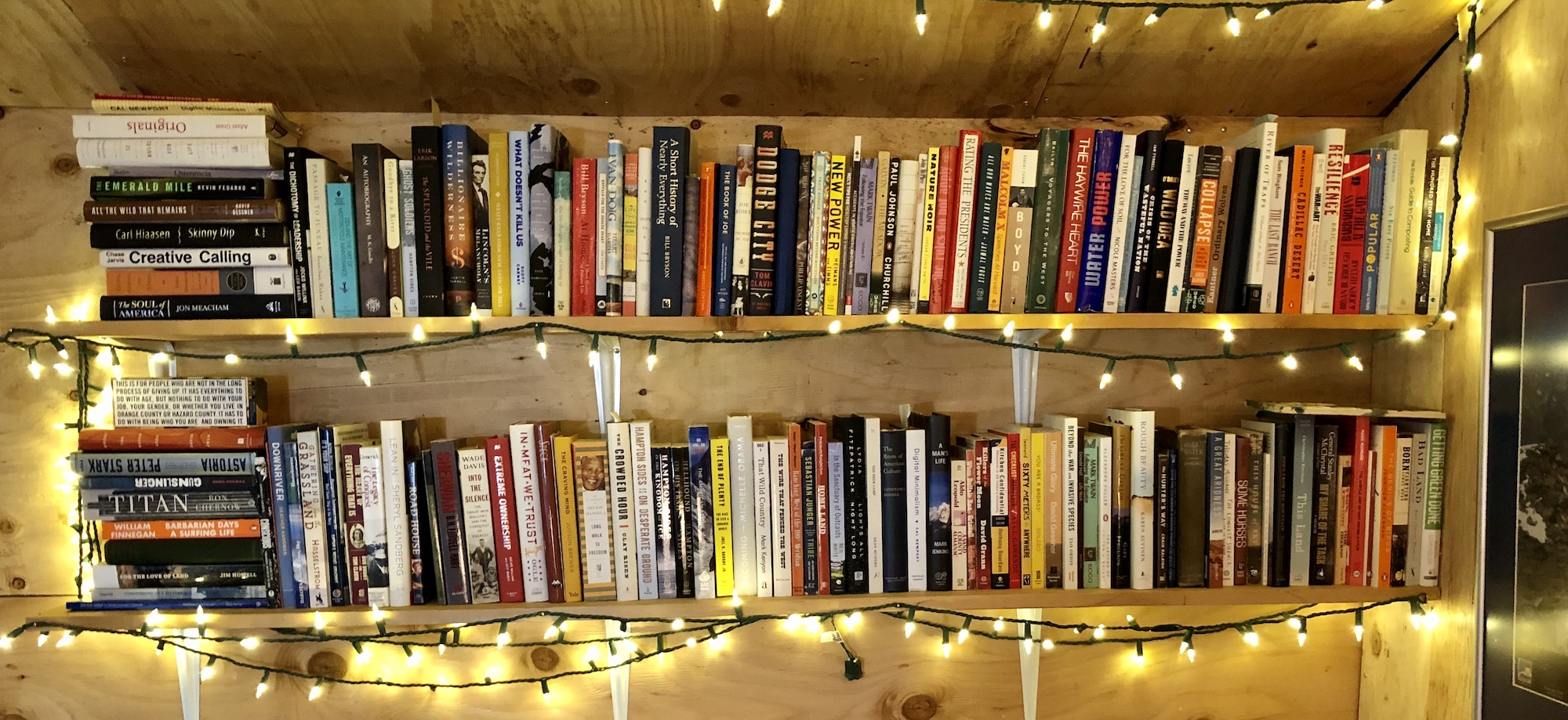
A comprehensive list of every book I recommended in 2025, taken directly from my bimonthly book recommendations emails.
The Extinction of Experience: Being Human in a Disembodied World by Christine Rosen – Ever since watching the hoverboard scene in Back to the Future II, I’ve dreamed about the fun-filled technological wonders awaiting me at some distant point in the future. Unfortunately, after finishing this excellent-yet-alarming book, I realized that the tech future is already here– and it’s more Freddy Krueger than Marty McFly. Rosen argues that internet-based technology has seeped into almost every aspect of our lives, acting as an often-unnoticed “mediator of experience.” From online maps to endless digital photos to news to social media, these inescapable technologies change the way we experience reality, mostly for the worse. This is one of those books that supplied data and science to solidify the loose, uncomfortable ideas about technology already floating around in my head. She does not offer any actionable ideas about curbing technology usage, but she definitely increased my awareness (panic?) about the seriousness of the problem. [For actionable ideas, check out Cal Newport’s Digital Minimalism.]
Delorme Atlas & Gazetteer: Colorado – From 2005 until about 2012, Delorme Gazetteers guided me all over the West, from the desolate canyons of Utah to the most remote campsites in Montana. I bought a new Colorado version as a direct result of Rosen’s book above, mostly as a (probably silly) rejection of map apps. After it arrived, I found myself studying it intensely for long stretches of time– exploring all of the memorable mountains and rivers and campsites that I’ve had the privilege of visiting over the years. I was reminded how much I LOVE paper maps– the more detailed the better. I begrudgingly admit that I’ll rarely use it for driving, but I will definitely enjoy continuing to “read it” and share it with my girls. [For some fascinating insights into how different cultures have thought about mapping terrain, read The Sea People by Christina Thompson.]
Pain Don’t Hurt: Meditations on Road House (Second Edition) by Sean T. Collins – Without question, this is the funniest book I have ever read. I cannot remember ever laughing so hard and for so long about anything, much less a book. Days and days of hysterical, tear-and-stomach-cramp inducing laughter. It’s a collection of 365 essays about the greatest movie of all time, penned during 2019, soon after Collins had the passing thought, “I could write about Road House everyday for a year and never run out of things to say.” He analyzes every detail of the movie (even scenes/characters I’d never considered), and even offers a few new-to-me, mind-blowing theories (Jimmy is Brad Wesley’s son?!). If you love Road House, you need to own this book. But you better act fast, because as of this moment, there are only 15 copies remaining of this limited edition run. [If you’re wondering “Is Ed referring to Swayze Road House or Gyllenhaal Road House?,” please unsubscribe from this email right now.]
The Terminal List and True Believer by Jack Carr – Every so often, I pick up a book for nothing but pure fun and entertainment, just as I would watch such masterpieces as Rambo III, Commando, Predator, Red Dawn, and, of course, Road House. If you enjoy these types of films and also like to read the occasional novel, Jack Carr is your man. These are the first two titles in his James Reece series, which follow the revenge-fueled adventures of a former Navy SEAL with nothing to lose. These two books are nearly a combined 1,000 pages, and I cranked through them both in just a few days each. Pure action and fun and a perfect way to unplug from the real world for a while. You’ll see many more of these books in these emails, for sure. [On the far opposite end of the novel spectrum, Wendell Berry’s Jayber Crow is still in the lead as the best novel I’ve ever read. (Also, in the history of humanity, have Dynamic Duo of Carr and Berry ever been recommended in the same paragraph?)]
Surviving Denali: A Study of Accidents on Mount McKinley 1903-1990 by Jonathan Waterman – This book had been sitting on my shelf for years, unread. I randomly picked it up last month and couldn’t put it down. As the title explains, it’s a deep dive into all of the chaos that has gone down on North America’s highest peak– a landscape with a knack for breaking and/or freezing humans in a surprisingly wide variety of ways. The responsible version of myself would recommend that anyone interested in climbing the mountain should read this book first. On the other hand, I’m glad I didn’t read it before my two Denali trips, because I likely would’ve been too scared to actually set foot on the Kahiltna Glacier. But anyone who enjoys mountaineering literature and history will love this book. It’s the real deal– extremely well written, highly educational, and not at all sensational or dramatic. [Speaking of Denali, I’m almost done with Cassidy Randall’s amazing new book Thirty Below: The Harrowing and Heroic Story of the First All-Women’s Ascent of Denali. Stay tuned for my full recommendation… and a podcast chat!]
American Flannel: How a Band of Entrepreneurs Are Bringing the Art and Business of Making Clothes Back Home by Steven Kurutz – For the last few weeks, I’ve been going deep into the history of natural fiber (i.e., cotton, wool, and leather) production in the United States. Long story short, the fabric/clothing industry had long been a bedrock of the US economy, until policy changes in the 1990s forced most of the production overseas. The aftermath has been a total economic disaster for many communities near and dear to my heart, particularly the milltowns in my homestate of North Carolina and many of the farming/ranching communities that produced the raw materials. Thankfully, I didn’t have to read a bunch of boring industry reports or academic papers to get my head around this subject. Instead, Kurutz’s fun-to-read, relatively short narrative gave me a thorough education on the topic via a bunch of colorful, crazy, rebellious characters who are hellbent on making American-made clothing popular and profitable (again). If you love against-the-odds business stories plus in-depth history, check this one out. [It’s very far from the made-in-America ethos, but my favorite crazy-entrepreneur book isShoe Dog by Phil Knight.]
And three more great books written by equally great people:
- The Deck, Stories From a Pandemic by Taylor and Cody Watts – While fully grown adults (like me) struggle for years with their own writing projects, Taylor and Cody (still in high school!) publish a remarkably insightful book about their family’s experience during the pandemic. Endorsed not just by me, but by people who actually know what they are doing, such as David James Duncan and Chris Dombrowski.
- Good Hunting for Kids: Growing Up to Be the Best Hunter You Can Be by Allen Morris Jones – Ever since I brought home 150 pounds of elk meat for my family, my girls have been fascinated by hunting. So I’m thankful that my pal Allen Morris Jones applied his artist’s mind to making the subject more understandable, approachable, and entertaining for curious, outdoor-loving kiddos like mine.
- Echolocation by Sage Marshall – I continue to be poetry curious, but also continue to have no idea where to even start. I’m always happy when a gifted outdoor/conservation-focused writer like Sage publishes a collection of poetry, because I know it’ll be just what I need to read. I loved this book and will revisit it for many years to come.
Lorne: The Man Who Invented Saturday Night Live by Susan Morrison – Most of my middle school weekends revolved around the same routine: Saturday evening, program the VCR to record channel 7 from 11:27 PM – 1:03 AM; Sunday morning, laugh hysterically at SNL skits, while pausing it whenever my parents walked through the room so they wouldn’t hear the crass jokes and make me turn it off. The longer SNL has been on the air, the more I’ve been intrigued by Lorne Michaels– how is it possible to keep a mainstream TV show edgy, funny, and relevant for decades on end? How can a person stay true to their creative vision and have big-time commercial success… without being considered a “sellout?” If you’ve ever wondered these things– or just crave hilarious stories about Will Ferrell– this is your book. At 600+ pages, it’s a big one, but I cranked through effortlessly. [My now-second-favorite SNL book is Live From New York: The Complete, Uncensored History of Saturday Night Live as Told by Its Stars, Writers, and Guests by Tom Shales. It’s worth reading the entire thing just for the part about Steven Seagal.]
Thirty Below: The Harrowing and Heroic Story of the First All-Women’s Ascent of Denali by Cassidy Randall – Up until Thirty Below, the only Denali-focused story I’d read that accurately captured the intensity and insanity of North America’s highest peak was Jon Krakauer’s Club Denali, which was published in Eiger Dreams. Not only did Thirty Below satiate my desire for more Denali-focused writing, but it filled in an embarrassing gap in my knowledge: The first all-women’s ascent in 1970. To me at least, 1970 doesn’t seem like all that long ago, but the obstacles and archaic ideas that these women had to overcome to simply get to the glacier, much less climb the dang thing, were insane. In many ways, climbing the mountain was the easy part– dealing with all of the arrogant, patronizing blowhards who dismissed them was a feat of world-class endurance. Like any great writer, Cassidy combines meticulous research with engaging characters and top-notch writing, and, more importantly, she brings these long-overlooked women to the forefront of mountaineering history. [To learn about Cassidy’s process for writing the book, check out our fun podcast conversation.]
Uplifted: The Evolution of a Climbing Life by Sonnie Trotter – So many mountain adventure memoirs are written by hardcore athletes who seem to be driven by some sort of darkness– an often anger-fueled desire to push beyond the edge to prove something either to themselves or their naysayers. In the world of rock climbing, Sonnie Trotter is about as hardcore as one can be– yet he’s driven by gratitude, adventure for adventure’s sake, and, dare I say, fun. I get a kick out of stories of brooding souls as much as the next guy, but it was so refreshing to read about a world-class athlete who’s driven by curiosity and optimism. As a bonus, the book is written in a refreshingly user-friendly style– it’s accessible to everyone, from veteran climbers to people like me, whose climbing career equals chaperoning their seven-year-old daughter at the climbing gym. You don’t have to zoom out much to see that, at its core, Uplifted is a book about turning your passion into a vocation– a universal theme that most thoughtful people will connect with. [I chatted with Sonnie about the book, and he was just as friendly and humble in conversation as he is on the page.]
Savage Son by Jack Carr – This is the third book in Carr’s James Reece series, and if I were forced to rank them, I would say Savage Son is my favorite so far. If you watch enough interviews with Carr, you’ll realize pretty quickly that he’s a PhD-level student of the thriller genre. He’s been reading them voraciously since he was a kid and now interviews many thriller authors on his podcast, so he knows what makes for a page turner. Combine his thriller obsession with the discipline he brings to the craft of writing, and you have a Tom Clancy-esque writing empire. Not bad for a guy who didn’t start writing seriously until after retiring from a highly decorated 20-year career in the Navy. As many of y’all know, I don’t read much fiction, but I’ll be reading this entire series. [If you’re interested in Carr’s writing process, these two videos (one and two) offer some actionable insights.]
The Farmer’s Wife: My Life in Days by Helen Rebanks – An author friend of mine sent me Helen’s book along with one simple endorsement: “It’ll knock your socks off.” Well, it knocked them off so aggressively that I begged the team at the Old Salt Festival to fly Helen across the ocean so I could interview her on stage at this summer’s event. While I’m not a farmer or a mother or a wife or much of a cook, I connected deeply with Helen’s story. Through beautiful prose, she celebrates the “mundane” parts of life– the chaos of raising children, the stress of trying to keep all the balls in the air, and the often futile attempts to find balance everything professionally, financially, and personally. You know, the regular stuff that actually makes up most of life. Even though, on the surface, our lives and careers are vastly different, I found great solace in Helen’s approach to celebrating both the challenges and the joys of life, of embracing gratitude and giving others grace. When it comes to those ways of thinking, I need all the help I can get! [One-third of Nick Offerman’s Where the Deer and the Antelope Play is devoted to his adventures with Helen and her husband James on their farm in the UK.]
Mark Twain by Ron Chernow – Like The Power Broker, this monster of a biography is taking me a very long time to read. But I’m far enough in to go ahead and give it my full-blown endorsement. Like so many legends of American history, Twain is a fascinating human to learn about, but if I could go back in time, I highly doubt I’d enjoy spending more than a few hours with him in person. I have the utmost respect for how he pulled himself out of poverty and staked his claim as a writer, humorist, and pundit, but, even with Chernow’s masterful explanations, I cannot understand why a person would be so brash, pugilistic, and impulsive. Pick any larger-than-life figure, and the story is so often the same: The personality traits that make them successful are also the most self-destructive thorns in their sides. But thankfully, I’m not looking for a new best friend, I’m looking for a great story– and Chernow nails it. Twain is so complex, ever-evolving, and hypocritical that it takes a full 1,000 pages to fully examine his wild life and personality. I’ll continue to happily chip away at this behemoth between more reasonably sized books. [My favorite book that demonstrates the light and dark sides of larger-than-life personalities is The Last American Man by Elizabeth Gilbert.]
A Worthy Expedition: The History of NOLS by Kate Dernocoeur – Back in 1999, I managed to talk my way into a semester’s worth of college credit in exchange for spending three months learning to climb, backpack, and sail around the Pacific Northwest with the National Outdoor Leadership School (NOLS). Founded by yet another larger-than-life character, Paul Petzoldt, NOLS unceremoniously began 60 summers ago in Wyoming’s Wind River Range. Since then, it has evolved into the premier outdoor education and leadership school in the world. This book combines hardcore historical research with a fun-to-read writing style and is mandatory reading for anyone who values the outdoors and experiential education. I’m obviously biased, but I feel like this book should be prominently stocked in every REI and mom-and-pop outdoor store in the country. [Another NOLS book that holds a perpetual, arm’s-length spot on my desk is Wilderness Wisdom.]
The Swamp: The Everglades, Florida, and the Politics of Paradise by Michael Grunwald – I was browsing a local bookstore while visiting the Carolina coast, and this book caught my eye. Having never heard of it, I was instantly convinced to buy it by the glowing blurb from my all-time favorite Florida writer, Carl Hiassen: “The best thing I’ve ever read about the Everglades.” I cannot overstate how much I enjoyed this book. In the style of Hampton Sides or David Grann, Grunwald takes dense, complex history and makes it read like a novel. He’s also surprisingly funny, which is quite an accomplishment when you consider how depressing the destruction of the Everglades has been. As much as I’m intrigued by Florida, what struck me most about this book was how our conquest of the Everglades seemed to become a blueprint for our conquests out West. From the tactics used to eliminate the Indigenous populations, to the obsession with making land “productive,” to the eventual bone-headed development (i.e., destruction) of a fragile ecosystem, the history of the Everglades allowed me to better understand the history of many of our imperiled wild places. [Sara Dant’s Losing Eden is my go-to for learning about the environmental history of the western U.S.]
Grasslands: Painting the American Prairie by James Prosek – James has built a legendary career on his process of becoming fully obsessed with a certain aspect of ecology, relentlessly exploring that idea through art and writing, then producing one-of-a-kind work that communicates his discoveries. I’ve recommended many of his books in these emails, with one of my favorites being Ocean Fishes. In this book, he turns his attention to grasslands and dives into not just specific species of the Great Plains, but into exploring the ideas of what concepts like “native species” even mean. He combines his philosopher’s mind with his artist’s eye, drawing, painting, and sculpting artwork that will make you reconsider your relationship with the land next time you’re cruising through wide-open prairies.
Burn by Peter Heller – Back in the spring of 2019, I read Peter Heller’s The Dog Stars, which painted a way-too-vivid picture of life in Colorado after a global pandemic. I remember thinking, “Yeah, that’s pretty scary, but it could never happen.” Then one year later, in the spring of 2020, we all know what happened. When I finished Burn, an excellent-but-terrifying story of a violent societal uprising followed by the government’s brutal response, I thought, “Yeah, that’s scare and it could happen.” But I guess the sign of a good novel is that it actually makes you feel something, and, now, every time I make the mistake of looking at internet “news,” I think about Burn. As is the case with all of Heller’s novels, this one is action-packed, fast-paced, and full of memorable, flawed, complex characters. It’s a great read, and, for me at least, definitely worth the trade-off of a little extra anxiety. [If you want the opposite of anxiety, read Wendell Berry’s Jayber Crow.]
The Way Out: A True Story of Survival in the Heart of the Rockies by Devon O’Neil – If you listen to my podcast, then you’re already familiar with The Way Out. And if you’re a fan of Krakauer’s Into the Wild or Into Thin Air, or Junger’s The Perfect Storm, then you’ll love this book. It’s the story of a low-key backcountry ski trip gone horribly wrong, one epic survival story, one tragic death, and the tight-knit mountain community that has to come to grips with heartbreak and loss. This book is especially important for those of us who are drawn to adventure in wild places–and especially those of us who try to explain away the inherent risk that comes with spending time in potentially deadly environments. Devon was the perfect person to tell this story–the compassion and empathy he brings to his reporting is obvious, and his commitment to telling the story completely and fairly is a case study in responsible journalism. A very important book. [If you haven’t already, check out my conversation with Devon.]
Simple Fly Fishing and Pheasant Tail Simplicity by Yvon Chouinard, Craig Mathews, and Mauro Mazza – These two books (and the next one below) fall into the category of “You might think this is a book about X, but it’s actually about Y.” On the surface, these books seem to be about how to become a better fly fisherman–but not through buying a truckload of expensive gear or filling your vest with 2,000 fancy-looking flies. The authors, who are all more accomplished anglers than at least 99.99% of the people reading this email, insist that the secret to mastering the art of fly fishing is to SIMPLIFY. In the case of Simple Fly Fishing, throw away your reel. In the case of Pheasant Tail Simplicity, use only one type of fly. By applying constraints, embracing curiosity, and reducing the process to its purest essence, one can finally begin the journey of becoming a master. And whaddaya know, this idea of embracing simplicity can also be applied to all parts of our lives: from work to play, creative endeavors to interpersonal relationships. As society becomes increasingly complicated, the idea of simplification becomes increasingly attractive. [I had the great pleasure of chatting with Yvon Chouinard about simplicity in fishing and life–full of laughs, full of wisdom.]
Little Woodchucks: Offerman Woodshop’s Guide to Tools and Tomfoolery by Nick Offerman with Lee Buchanan – On the surface, this is a fun, funny, photo-filled instruction manual for teaching kids how to build things from wood, by hand. Nick covers everything from choosing your tools, to setting up your workspace, to completing 12 different projects, including a box kite, a little free library, and a toy truck. It’s real fun–the kind of rewarding undertaking that lets children use their brains, learn a skill, and create a real-world, tactile object that they can hold in their hands. But when you dig a little deeper, Little Woodchucks is about rejecting the brain-rotting pull of the internet, shunning the hypnotic pull of social media, and working alongside like-minded people to create useful, pride-inducing keepsakes. In my humble opinion, no matter our age, we will probably all benefit from a little less swiping and more real-world craftsmanship. (If you’re a bigger woodchuck who’s looking for more advanced projects and fun/wise Offerman-esque philosophy, check out Nick’s Good Clean Fun.]
Dirtbag Billionaire: How Yvon Chouinard Built Patagonia, Made a Fortune, and Gave It All Away by David Gelles – Even though I’d spent the past 20 years reading and watching pretty much everything about Yvon Chouinard and Patagonia, I learned a ton from this biography. Gelles is an accomplished New York Times journalist who, after ripping Jack Welch to shreds, turned his attention to Chouinard. (Spoiler alert: He seems to admire Yvon a lot more than Jack.) Gelles chronicles Chouinard’s life from rambunctious youngster to climbing icon to business innovator to super philanthropist who, in 2022, gave his multi-billion-dollar company away. While I loved the insights into Chouinard’s personality and vision, I especially enjoyed learning more about his colleagues and teammates who played invaluable roles in Patagonia’s success, particularly Kris Tompkins. Gelles paints a fair picture of the entire Patagonia enterprise, exploring the contradictions and paradoxes of building a high-impact consumer goods company that is also real-deal committed to making the world a better place. A good reminder that nothing is straightforward, everything is nuanced, and the most interesting people are complex. [The ethos of Nike founder Phil Knight couldn’t be further from Yvon’s, but Knight’s memoir Shoe Dog is one of my all-time favorite business memoirs.]
Apple in China: The Capture of the World’s Greatest Company by Patrick McGee – Back when I was in business school, my least favorite subject, hands down, was operations. Endless yammering about factories, assembly lines, “lean manufacturing,” “Six Sigma black belts,” and a bunch of other lingo that my brain seemed violently allergic to. So I was quite surprised to find myself completely engrossed by a 400+-page book about the global supply chain that produces iPhones. But seriously… it was fascinating. And at times… infuriating. The quick summary is that a small number of Chinese manufacturers patiently and ingeniously built a system that all but forced Apple to not only hire them to assemble its products, but also to build its factories, train its workers, and inject billions and billions of dollars of economic stimulus into the Chinese economy. And over the course of three or four decades, China grew into the economic and political powerhouse that it is today. Now that it’s finished helping China, perhaps Apple can figure out a way to inject a few hundred billion into its home country’s public schools and/or healthcare system. [Another head-spinning business book that I think of often is When McKinsey Comes to Town by Walt Bogdanich and Michael Forsythe.]
The Devil’s Hand by Jack Carr – You have probably noticed that Jack Carr novels have a seemingly permanent position in my book recommendations. This will continue until I have read them all. They’re not for everyone, but if you like movies like (or YouTube clips from) Rambo, Commando, Man on Fire, Taken, John Wick, The Equalizer, Bourne Identity, etc., I can guarantee you’ll love these books. [For a thoroughly hilarious take on the best of this type of movie, read Pain Don’t Hurt: 365 Meditations on Road House by Sean T. Collins. It’s a masterpiece.]